
World-Class Learning. Anytime. Anywhere. |
At Lingo Global, every course is crafted with purpose. We don’t believe in one-size-fits-all education. Each program is built around clear learning outcomes, expert instruction, and the real needs of modern learners — whether you’re preparing for a high-stakes exam, developing your professional English, or stepping into the exciting world of AI-powered creativity.
All courses are delivered entirely online, giving you the flexibility to learn on your schedule without compromising on quality. Below you’ll find our full suite of courses, each with detailed outlines to help you understand exactly what you’ll achieve.







Course Description
The future of storytelling is here — and it’s powered by artificial intelligence. The Lingo Global AI Animation course is a groundbreaking online program that takes you from zero to creator, teaching you how to use cutting-edge AI tools to produce professional-quality animations, visual narratives, and motion content without needing years of technical training.
This course is perfect for aspiring animators, content creators, educators, marketers, and anyone who wants to bring ideas to life through the most exciting creative technology of our time. No prior animation experience required — just creativity and curiosity.
What You Will Learn
- Understand the landscape of AI-driven animation tools and platforms
- Generate and refine AI-powered visual assets and character designs
- Build animated sequences using text-to-video and image-to-animation AI
- Script, storyboard, and produce short animated films
- Combine AI tools with storytelling principles for maximum impact
- Export and publish polished animations for social media, education, or business.
Course Outline
Module 1: Introduction to AI Animation
- What is AI Animation and why it matters in 2026 & beyond?
- Overview of the AI creative ecosystem
- Key platforms: Runway, Pika, Kling, and more
- Setting up your AI toolkit and workflow
- Your first AI-generated image and animation clip
Module 2: Visual Storytelling Fundamentals
- The principles of animation: timing, motion, emotion
- Storyboarding your ideas from concept to screen
- Character design using AI image generation
- Color, composition, and visual language
- Hands-on project: Design a character and scene
Module 3: Text-to-Video & Image Animation
- Using text prompts to generate video sequences
- Animating still images with AI motion tools
- Refining and iterating on AI-generated outputs
- Layering motion, transitions, and effects
- Mini project: Create a 30-second animated sequence
Module 4: Scriptwriting & Narrative for Animation
- Writing effective scripts for animated content
- Dialogue, pacing, and visual narrative structure
- Matching voice and tone to visual style
- AI tools for script generation and refinement
- Developing your animated story concept
Module 5: Advanced AI Animation Techniques
- Combining multiple AI tools in a single workflow
- Lip sync, voice cloning, and AI audio integration
- Creating explainer animations for education and marketing
- Looping animations and social media-ready formats
- Peer review and creative critique sessions
Module 6: Final Project & Portfolio
- Planning and producing a complete 2-3 minute animated piece
- Feedback sessions and revision process
- Exporting, publishing, and presenting your work
- Building an AI animation portfolio
- Career pathways in AI creative production
Course Details
Course Description
IELTS — the International English Language Testing System — is the world’s most recognised English proficiency qualification, accepted by thousands of universities, employers, and immigration authorities across the globe. Achieving your target band score can be the difference between your dream future and a closed door. Lingo Global’s IELTS Preparation course is a comprehensive online program built to help you get the score you need.
Our course covers both Academic and General Training pathways and prepares you for all four skills: Listening, Reading, Writing, and Speaking. With dedicated modules for each component, authentic practice materials, and personalised feedback from experienced IELTS-qualified tutors, this course gives you everything you need to walk into the exam room with complete confidence.
Who Is This Course For?
- Students applying to universities in the UK, Australia, Canada, or USA
- Professionals seeking work visas or international employment
- Individuals applying for immigration and residency programs
- Anyone aiming to achieve Band 6, 7, 8, or beyond
What You Will Learn
- Master all four IELTS skills: Listening, Reading, Writing, Speaking
- Understand the scoring criteria for Writing Tasks 1 and 2
- Apply proven strategies for IELTS Reading question types
- Build the vocabulary range required for a high band score
- Prepare for the Speaking test with structured practice and feedback
- Complete full mock tests under real exam conditions
Course Outline
Module 1: IELTS Overview & Exam Orientation
- Understanding the IELTS format: Academic vs. General Training
- How IELTS is scored: band descriptors explained
- Setting your target score and planning your preparation
- Diagnostic full test: benchmarking your current level
- Building your personalised study timeline
Module 2: IELTS Listening
- Listening section overview: four parts, question types
- Strategies for each question format: multiple choice, gap fill, matching
- Predicting answers and listening for key words
- Handling different accents: British, Australian, American
- Full Listening practice tests with answer analysis
Module 3: IELTS Reading
- Reading section overview: Academic and General Training differences
- True/False/Not Given and Yes/No/Not Given — mastering the most feared question type
- Matching headings, sentence completion, and summary tasks
- Time management: reading efficiently under pressure
- Six graded reading practice sessions with full review
Module 4: IELTS Writing Task 1
- Academic Task 1: describing graphs, charts, diagrams, and maps
- General Training Task 1: formal and informal letter writing
- Band scoring criteria: Task Achievement, Coherence, Lexical Resource, Grammar
- Structuring an overview and selecting key features
- Instructor-marked sample responses and detailed feedback
Module 5: IELTS Writing Task 2
- Understanding essay types: opinion, discussion, problem-solution, two-part questions
- Planning and structuring a Band 7+ essay in 40 minutes
- Academic vocabulary for arguments and analysis
- Cohesion devices: linking ideas effectively
- Three marked essays per student with upgrade guidance
Module 6: IELTS Speaking
- Speaking test structure: Parts 1, 2, and 3
- Fluency, coherence, and avoiding hesitation traps
- Lexical resource and grammatical range in spoken English
- Cue card preparation and long-turn strategies for Part 2
- One-to-one mock Speaking test with band score feedback
Module 7: Full Mock Tests & Final Preparation
- Two complete timed IELTS mock tests (Academic or General)
- Detailed performance analysis across all four skills
- Targeted revision based on mock test results
- Test-day logistics, strategies, and mental preparation
- Final checklist and confidence-building session
Course Description
The SAT is the gateway to top universities across the United States and beyond — and the Evidence-Based Reading and Writing section is where great scores are made or lost. Lingo Global’s SAT English course is a precision-engineered online program that dismantles every question type, builds the skills you need, and trains you to work efficiently under exam pressure.
Our experienced SAT coaches understand the test inside and out. This course is not about cramming — it’s about building the genuine reading comprehension and writing analysis skills that the SAT is designed to test. Students who complete this course consistently achieve significant score improvements.
What You Will Learn
- Master SAT Reading question types: detail, inference, vocabulary-in-context, evidence
- Develop strategies for passage-based reading across science, history, and literature
- Excel in SAT Writing & Language: grammar, expression of ideas, and rhetoric
- Build a high-level SAT vocabulary in context
- Apply time management strategies for each section
- Complete multiple full-length practice tests with performance analysis
Course Outline
Module 1: SAT Structure & Strategy Overview
- How the SAT Evidence-Based Reading & Writing sections are structured
- Scoring system: raw scores, scaled scores, and percentiles
- The mindset for high-performance test taking
- Diagnostic test: identifying your strengths and target areas
- Building your personalised study plan
Module 2: SAT Reading — Core Comprehension
- Understanding the five SAT passage types
- Main idea, tone, and author’s purpose questions
- Command of evidence question pairs
- Vocabulary-in-context strategies
- Active reading techniques for speed and accuracy
Module 3: SAT Reading — Advanced Analysis
- Paired passage comparison and synthesis
- Interpreting data in graphics and charts
- Historical and foundational documents passages
- Science and social science passage strategies
- Timed passage drills with answer explanation
Module 4: SAT Writing & Language — Grammar Mastery
- Sentence structure: fragments, run-ons, and modifiers
- Subject-verb and pronoun-antecedent agreement
- Punctuation: commas, colons, semicolons, dashes
- Verb tense and mood consistency
- Targeted grammar drills and error correction
Module 5: SAT Writing & Language — Expression of Ideas
- Improving clarity, precision, and conciseness
- Passage organisation and logical sequence
- Introductions, conclusions, and transition strategies
- Rhetorical analysis: purpose and audience questions
- Style, tone, and word choice questions
Module 6: Full Practice Tests & Score Maximisation
- Two full-length timed practice SAT tests
- Detailed post-test analysis and pattern identification
- Targeted review of persistent weak areas
- Pacing strategies and guessing principles
- Final preparation and test-day readiness checklist
Course Description
The Cambridge O Level and IGCSE English examinations are among the most respected academic qualifications in the world — and performing well in them can open doors to top universities and international opportunities. Lingo Global’s O Level / IGCSE English course is a comprehensive, exam-focused online program designed to take students from foundational understanding to examination excellence.
Led by experienced Cambridge-qualified educators, this course covers every component of the examination: reading comprehension, directed writing, narrative and descriptive writing, and language analysis. Whether you’re a student preparing for your first sitting or seeking to improve your grade, this course gives you the skills, strategies, and confidence to succeed.
What You Will Learn
- Master reading comprehension strategies for inferential and literal questions
- Produce high-scoring directed writing responses
- Write compelling narrative, descriptive, and argumentative pieces
- Analyse language, structure, and effect in literary and non-literary texts
- Understand mark schemes and examiner expectations
- Practice with authentic past papers under timed conditions
Course Outline
Module 1: Understanding the Cambridge Examination
- Overview of O Level / IGCSE English papers and components
- How the mark scheme works: what examiners look for
- Managing time across paper components
- Common student mistakes and how to avoid them
- Diagnostic assessment: establishing your baseline
Module 2: Reading Comprehension Mastery
- Literal vs. inferential comprehension questions
- Identifying the writer’s purpose, tone, and viewpoint
- Selecting and using evidence effectively
- Summary writing: selecting, grouping, and expressing information
- Timed practice with past paper extracts
Module 3: Directed Writing
- Understanding directed writing tasks: reports, speeches, letters, articles
- Adapting purpose, audience, and format
- Structuring a high-scoring directed writing response
- Using language effectively and accurately
- Marked practice exercises with detailed feedback
Module 4: Narrative & Descriptive Writing
- The craft of narrative: plot, character, tension, atmosphere
- Techniques for vivid descriptive writing
- Opening and closing strategies that impress examiners
- Vocabulary enrichment and varied sentence structures
- Peer review and instructor feedback on writing samples
Module 5: Language Analysis
- Identifying and commenting on language devices
- Analysing structure, form, and effect
- Writing analytical paragraphs using PEE/PEEL/TEEL
- Comparing writers’ methods across two texts
- Building a vocabulary of analytical terminology
Module 6: Exam Preparation & Revision
- Full mock examination under timed conditions
- Detailed review of mock paper performance
- Revision of core skills and targeted weak areas
- Last-minute strategies and exam-day tips
- Checklist for peak exam performance
Course Description
Not everyone needs a full academic curriculum — sometimes you need practical English skills, quickly and confidently. Lingo Global’s Short English Language Courses are intensive, focused online programs designed for adults and learners who want to improve their spoken and written English for work, travel, daily communication, or personal development.
Our short courses are available at multiple levels — from elementary to upper intermediate — and are designed to deliver real, usable skills in the shortest possible time. Each course combines grammar, vocabulary, speaking, writing, and listening in an engaging, real-world format. Whether you want to sound more confident in business meetings, write better emails, or simply communicate more fluently in everyday life, there is a Lingo Global Short Course made for you.
Available Levels
- Elementary (A1–A2): Build your English from the ground up
- Pre-Intermediate (B1): Develop confidence in everyday communication
- Intermediate (B1–B2): Refine your skills for work and social situations
- Upper Intermediate (B2): Polish your English for professional and academic contexts
What You Will Learn
- Build practical vocabulary for real-world situations
- Master essential grammar structures clearly and confidently
- Write emails, messages, and short texts with clarity and accuracy
- Develop listening skills through authentic audio content
- Communicate with greater fluency and confidence
- Understand and use natural, everyday English expressions
Course Outline (Intermediate Level)
Module 1: Foundations: Grammar & Communication
- Review of key tenses: present, past, future
- Expressing ability, possibility, and obligation
- Sentence building: simple, compound, and complex sentences
- Common communication patterns in formal and informal English
- Speaking activity: introductions and everyday conversation
Module 2: Vocabulary in Context
- Topic-based vocabulary: work, travel, technology, health
- Collocation and common word partnerships
- Phrasal verbs for everyday use
- Idiomatic expressions and how to use them naturally
- Vocabulary building strategies: word families and context
Module 3: Reading & Listening Skills
- Strategies for reading articles, emails, and reports
- Skimming for main ideas, scanning for details
- Listening comprehension with authentic recordings
- Understanding accents and natural speech patterns
- Note-taking and comprehension practice
Module 4: Professional & Social Writing
- Writing professional emails: structure, tone, and language
- Formal vs. informal writing — knowing when to use each
- Short report and message writing
- Polishing grammar and punctuation in written English
- Peer review and instructor-marked writing tasks
Module 5: Spoken English & Fluency
- Pronunciation: stress, rhythm, and connected speech
- Having conversations: agreeing, disagreeing, asking questions
- Presenting ideas clearly and confidently
- Small talk and social English in professional settings
- Live speaking practice and feedback session
Module 6: Review, Assessment & Next Steps
- Consolidation of key skills from all modules
- End-of-course assessment with personalised feedback
- Progress report and achievement certificate
- Recommendations for continuing your learning journey
- Introduction to next-level course options at Lingo Global
Course Details
Course Description
Artificial intelligence is no longer a specialism — it is the layer every industry is being rebuilt on. The Lingo Global AI Full Engineering program is a complete eight-month journey that takes you from your very first line of Python to building autonomous agents and AI systems that act in the physical world. Each month is a self-contained stage with its own tools, labs and portfolio project, so you can see your progress build month after month rather than waiting until the end.
You will begin where the fastest results are — AI automation, wiring real tools together to remove real work — then move into the programming and mathematics that let you build systems of your own. From there the program climbs steadily through machine learning, deep learning, computer vision, generative AI, agentic AI, and finally physical AI, where models meet robotics, sensors and edge devices.
This is a practitioner’s program, not a lecture series. Every stage is built around work you can show: a deployed automation, a trained model, a vision pipeline, a generative application, a working agent. By the end you hold an eight-project portfolio and the vocabulary to work as an AI engineer. No prior programming experience is required — just consistency and curiosity.
WHO IS THIS COURSE FOR?
- Students and graduates who want a complete, structured route into AI engineering rather than scattered tutorials
- Working professionals — developers, analysts, engineers, marketers — who want to move into AI roles
- Business owners and freelancers who want to build and sell AI automation and AI products
- Educators and researchers who need practical, hands-on command of the modern AI stack
- Complete beginners: Stage 1 and Stage 2 assume no prior coding background professional and academic contexts
What You Will Learn
- Design and deploy end-to-end AI automation workflows that connect real business tools and APIs
- Write production-quality Python and work confidently with data using industry-standard libraries
- Build, train, evaluate and tune machine learning models on real datasets
- Construct and train deep neural networks, and understand what is happening inside them
- Develop computer vision systems for detection, recognition, segmentation and tracking
- Build generative AI applications with large language models, RAG pipelines and diffusion models
- Engineer autonomous, tool-using AI agents that plan, reason and execute multi-step tasks
- Take AI off the screen — deploy models to robots, drones, sensors and edge hardware
- Ship, document and present a professional eight-project AI engineering portfolio
Course Outline (Intermediate Level)
Stage 1 — Month 1: AI Automation
The AI automation landscape: what to automate, what never to automate
Building no-code and low-code workflows with n8n, Make and Zapier
Working with APIs, webhooks, authentication and JSON data
Connecting AI models into business workflows: email, CRM, documents, spreadsheets, chat
Error handling, logging, scheduling and keeping automations alive in production
Stage project: a deployed multi-step automation that removes a real recurring task
Tools & Software: n8n, Make, Zapier, Google Workspace APIs, Postman, OpenAI / Claude APIs,
Airtable, Slack
Stage 2 — Month 2: Python Programming for AI
Python from zero: syntax, data types, control flow, functions, error handling
Object-oriented programming, modules, packages and virtual environments
Data handling with NumPy and pandas: cleaning, reshaping, joining, aggregating
Visualisation with Matplotlib and Seaborn; reading data like an engineer
Version control with Git and GitHub, plus notebooks vs. scripts vs. production code
Stage project: an end-to-end data analysis on a real public dataset, published to GitHub
Tools & Software: Python 3, Jupyter / Google Colab, VS Code, NumPy, pandas, Matplotlib, Seaborn,
Git, GitHub
Stage 3 — Month 3: Machine Learning
How machines learn: supervised, unsupervised and the bias–variance trade-off
Regression, classification, decision trees, random forests and gradient boosting
Clustering, dimensionality reduction and anomaly detection
Feature engineering, pipelines, cross-validation and hyperparameter tuning
Honest evaluation: accuracy, precision, recall, F1, ROC-AUC — and why accuracy lies
Model deployment basics: saving, serving and exposing a model as an API
Stage project: a trained, evaluated and deployed predictive model with a live demo
Tools & Software: scikit-learn, XGBoost, pandas, Optuna, MLflow, FastAPI, Streamlit, Hugging Face
Spaces
Stage 4 — Month 4: Deep Learning
Neural networks from first principles: neurons, layers, activations, loss functions
Backpropagation, gradient descent, optimisers and learning-rate strategies
Regularisation, dropout, batch normalisation and fighting overfitting
Convolutional and recurrent architectures; an introduction to transformers and attention
Transfer learning and fine-tuning pre-trained models on your own data
Training at scale: GPUs, mixed precision, checkpointing and experiment tracking
Stage project: a custom deep learning model trained and fine-tuned on a domain dataset
Tools & Software: PyTorch, TensorFlow / Keras, Google Colab GPU, Hugging Face Transformers,
Weights & Biases, TensorBoard
Stage 5 — Month 5: Computer Vision
Image fundamentals: pixels, colour spaces, filtering and classical OpenCV techniques
Image classification and transfer learning with modern vision backbones
Object detection and segmentation with the YOLO family and Segment Anything
Face detection, OCR, pose estimation and multi-object tracking
Video pipelines: real-time inference, streaming and performance optimisation
Vision in the real world: quality inspection, retail analytics, security and medical imaging
Stage project: a real-time vision application running on live camera input
Tools & Software: OpenCV, Ultralytics YOLO, Roboflow, MediaPipe, Segment Anything, Tesseract
OCR, PyTorch Vision
Stage 6 — Month 6: Generative AI
How large language models actually work: tokens, context, embeddings, sampling
Professional prompt engineering, structured outputs and evaluation of generated text
Retrieval-Augmented Generation: chunking, embeddings, vector databases and grounding
Fine-tuning and parameter-efficient adaptation (LoRA / QLoRA) on your own data
Image, audio and video generation with diffusion models; multimodal applications
Cost, latency, safety, hallucination control and responsible deployment
Stage project: a deployed RAG-powered generative application over your own document
set
Tools & Software: OpenAI / Claude / Gemini APIs, LangChain, LlamaIndex, Hugging Face, Pinecone /
Chroma, Ollama, Stable Diffusion, ElevenLabs
Stage 7 — Month 7: Agentic AI
From chatbots to agents: goals, planning, memory, reflection and tool use
Function calling and giving an agent safe, scoped access to real systems
Single-agent and multi-agent architectures; orchestration, hand-offs and supervision
Short-term and long-term memory, state management and context engineering
Building agents with LangGraph, CrewAI and the Model Context Protocol (MCP)
Evaluating, guard-railing, monitoring and costing agents in production
Stage project: an autonomous multi-step agent that completes a real workflow end to end
Tools & Software: LangGraph, CrewAI, AutoGen, MCP, OpenAI Agents SDK, vector stores, n8n,
Docker
Stage 8 — Month 8: Physical AI
Embodied AI: perception, decision and actuation loops in the physical world
Sensors and signals — cameras, LiDAR, IMU, depth — and sensor fusion basics
Robotics foundations with ROS 2: nodes, topics, simulation and control
Reinforcement learning for control, and simulation-to-reality transfer
Edge deployment: model compression, quantisation and inference on constrained hardware
Safety, reliability and testing for systems that move in the real world
Capstone project: a physical or simulated AI system that perceives, decides and acts —
plus your full portfolio review and career session
Tools & Software: ROS 2, Gazebo / Isaac Sim, NVIDIA Jetson, Raspberry Pi, OpenCV, PyTorch,
TensorRT, ONNX Runtime, Arduino
Course Details
Course Description
Every organisation now runs on systems somebody is trying to break into — and the people who
can find those weaknesses before attackers do are among the most sought-after professionals in
technology. The Lingo Global Certified Ethical Hacking program is a six-month, fully hands-on
route into professional cybersecurity, covering both sides of the fight: how attacks are carried out,
and how they are detected and stopped.
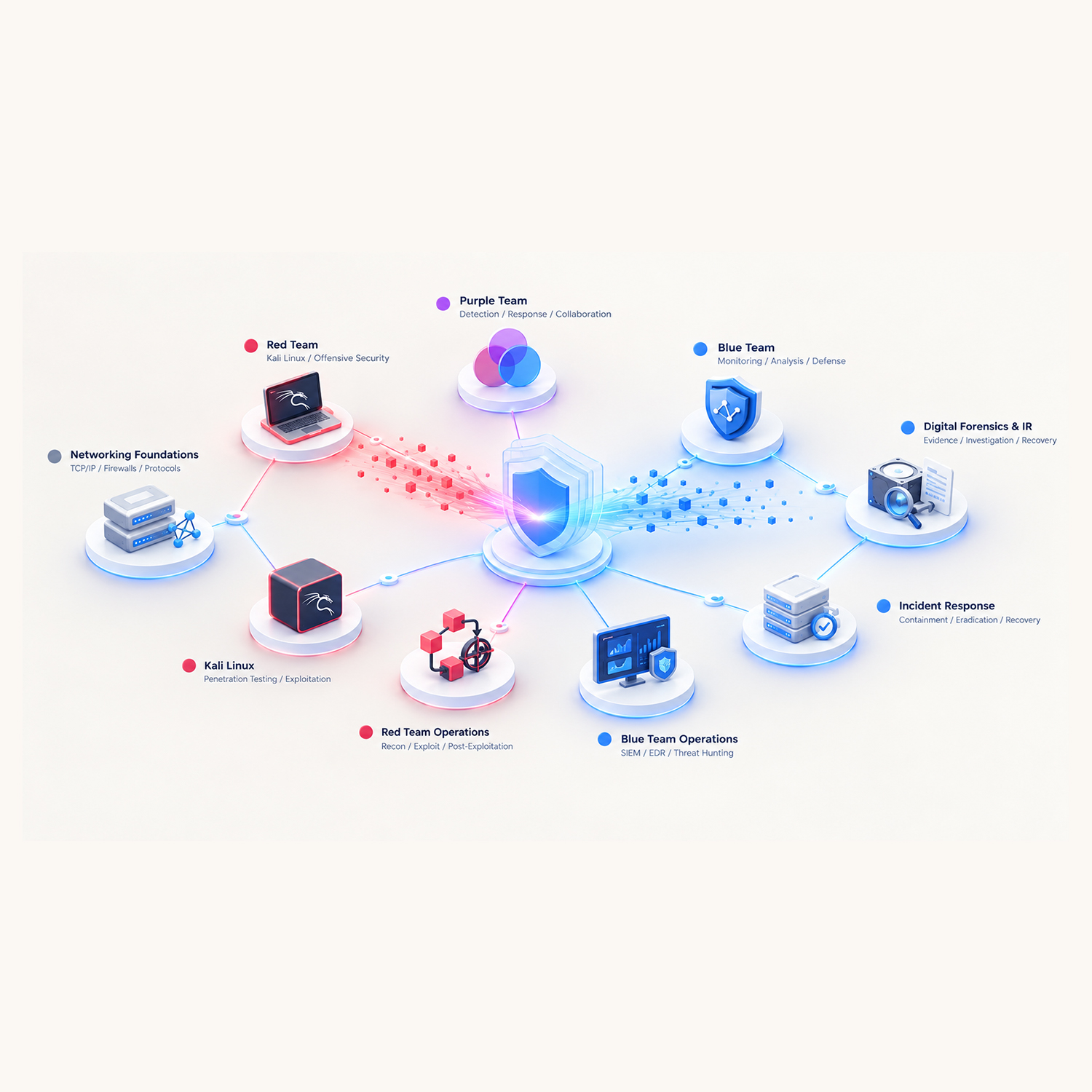
The program is built around the industry’s team model. You start with the networking and Linux
foundations every security professional is expected to have, then move into Red Team offensive
testing, Blue Team defence and monitoring, Purple Team collaboration where the two disciplines
meet, and finally digital forensics and incident response — the work of reconstructing what
happened after a breach.
All practical work is carried out in isolated, purpose-built lab environments, and the program is
taught with a strong emphasis on legal authorisation, scope and professional ethics. You finish
with a complete penetration-testing report, a detection-engineering portfolio and a forensic case
file — exactly the evidence security employers ask to see. No prior cybersecurity experience is
required.
WHO IS THIS COURSE FOR?
- Students and graduates targeting a career in cybersecurity, SOC analysis or penetration testing
- IT staff, network administrators and developers who want to move into a security role
- Professionals preparing for industry certifications and needing genuine hands-on lab practice
- Business and IT decision-makers who need to understand how their systems are actually attacked
- Complete beginners: Stage 1 and Stage 2 assume no prior security or Linux background
What You Will Learn
- Read, map and secure modern networks, and understand every layer an attacker moves
through - Operate Linux and Kali Linux confidently from the command line
- Carry out authorised penetration tests: reconnaissance, exploitation, privilege escalation,
reporting - Defend infrastructure with hardening, monitoring, SIEM analysis and threat hunting
- Run Purple Team exercises — emulate adversary behaviour and build the detections that catch
it - Investigate incidents forensically across disks, memory, networks and mobile devices
- Write professional, evidence-backed security reports that stand up to scrutiny
- Work within legal, ethical and regulatory boundaries at every stage
Course Outline (Intermediate Level)
Stage 1 — Month 1: Networking & Security Foundations
The OSI and TCP/IP models, and what an attacker sees at each layer
IP addressing, subnetting, routing, switching, NAT, DNS, DHCP and VPNs
Protocol analysis and packet capture: reading traffic and spotting anomalies
Firewalls, IDS/IPS, network segmentation and secure architecture principles
Core security concepts: CIA triad, threat modelling, risk, the cyber kill chain and MITRE
ATT&CK
Cyber law, authorisation, scope and professional ethics — the rules of engagement
Stage project: map, analyse and document the security posture of a lab network
Tools & Software: Wireshark, Nmap, tcpdump, Cisco Packet Tracer / GNS3, VirtualBox / VMware,
pfSense
Stage 2 — Month 2: Linux & Kali Linux Essentials
Linux fundamentals: filesystem, permissions, users, processes, services and logs
Command-line mastery and Bash scripting for security automation
Installing, configuring and maintaining Kali Linux; building a safe home lab
The Kali toolset: what each major tool category is for and when to reach for it
Python scripting for security: custom scanners, parsers and automation
Hardening a Linux host, plus Windows and Active Directory basics for attackers and
defenders
Stage project: a fully built personal lab plus a custom scripted security tool
Tools & Software: Kali Linux, Bash, Python, VirtualBox / VMware, Docker, Metasploitable, DVWA,
Windows Server lab VMs
Stage 3 — Month 3: Red Team — Offensive Security
Reconnaissance and OSINT: footprinting an organisation from public sources
Scanning, enumeration and vulnerability assessment
Exploitation with Metasploit and manual techniques; payloads and shells
Web application attacks: the OWASP Top 10, injection, XSS, authentication and accesscontrol flaws
Password attacks, privilege escalation, lateral movement and persistence
Wireless and social engineering attack techniques
Stage project: a full authorised penetration test of a lab environment, with a professional
report
Tools & Software: Metasploit, Burp Suite, Nmap, Nessus / OpenVAS, sqlmap, Hydra, John the Ripper,
Hashcat, Aircrack-ng, BloodHound, Gobuster
Stage 4 — Month 4: Blue Team — Defensive Security
Inside a Security Operations Centre: roles, workflow, triage and escalation
Log collection and analysis across endpoints, servers, network devices and cloud
SIEM in practice: building dashboards, correlation rules and alerts
Endpoint detection and response, malware behaviour analysis and containment
Threat intelligence, IOCs and proactive threat hunting
System hardening, patch management, access control and defence in depth
Stage project: detect, triage and document a simulated live attack as a SOC analyst
Tools & Software: Splunk, Elastic / ELK Stack, Wazuh, Security Onion, Suricata, Snort, Sysmon,
MITRE ATT&CK Navigator, TheHive
Stage 5 — Month 5: Purple Team — Adversary Emulation & Detection
Engineering
Why Purple Teaming exists: closing the gap between attack and detection
Adversary emulation — reproducing real threat-actor techniques against your own
environment
Mapping attacks to MITRE ATT&CK and measuring genuine detection coverage
Detection engineering: writing, testing and tuning rules that fire on the right things
Breach and attack simulation, purple-team exercise design and running the sessions
Reducing false positives, and reporting security improvement to management
Stage project: run a purple-team exercise — emulate an attack chain, then build and
validate detections for it
Tools & Software: Atomic Red Team, Caldera, Sigma rules, MITRE ATT&CK Navigator, Splunk / ELK,
Wazuh, PowerShell, VECTR
Stage 6 — Month 6: Digital Forensics & Incident Response
The incident response lifecycle: preparation, detection, containment, eradication, recovery
Evidence handling, chain of custody and forensic soundness
Disk and file system forensics; recovering deleted and hidden artefacts
Memory forensics and live response; extracting what only exists in RAM
Network, log, email and mobile device forensics
Malware triage, timeline reconstruction and root-cause analysis
Writing the forensic report and presenting findings to technical and legal audiences
Capstone project: a complete forensic investigation of a simulated breach — full case file,
report and presentation
Tools & Software: Autopsy, FTK Imager, Volatility, Wireshark, Velociraptor, Sleuth Kit, RegRipper,
Plaso / log2timeline, Cellebrite-style mobile toolkits next-level course options at Lingo Global